Can You Claim the Credit?The following rules will help you determine if you are eligible to claim the Hope credit on your tax return. Who Cannot Claim the Credit?You cannot claim the Hope credit if any of the following apply.
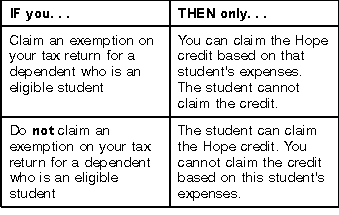
Who Can Claim the Credit?Generally, you can claim the Hope credit if you pay qualified tuition and related expenses of higher education for an eligible student who is either yourself, your spouse, or a dependent for whom you claim an exemption on your tax return. Qualified tuition and related expenses are defined later under What Expenses Qualify? Eligible students are defined later under Who Is an Eligible Student? Dependent for whom you claim an exemption. You claim an exemption for a person if you list his or her name on line 6c, Form 1040 (or Form 1040A). Who Can Claim A Dependent's Expenses?If there are higher education costs for your dependent for a year, either you or your dependent, but not both of you, can claim a Hope credit for that dependent's expenses for that year.
Expenses paid by dependent. If you claim an exemption on your tax return for an eligible student who is your dependent, treat any expenses paid by the student as if you had paid them. Include these expenses when figuring the amount of your Hope credit.
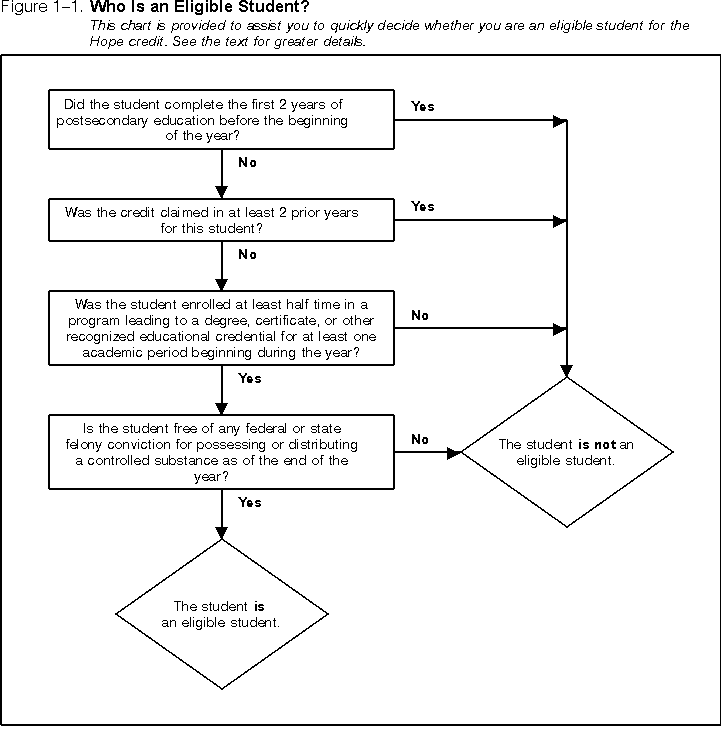
Expenses paid by others. If someone other than you, your spouse, or your dependent (such as a relative or former spouse) makes a payment directly to an eligible educational institution to pay for an eligible student's qualified tuition and related expenses, the student is treated as receiving the payment from the other person. The student is treated as paying the qualified tuition and related expenses to the institution. If you claim an exemption on your tax return for the student, you are considered to have paid the expenses. Example. Ms. Allen makes a payment directly to an eligible educational institution in 2001 for her grandson Todd's qualified tuition and related expenses. For purposes of claiming a Hope credit, Todd is treated as receiving the money as a gift from Ms. Allen and, in turn, paying his qualified tuition and related expenses himself. Unless an exemption for Todd is claimed on someone else's return, only Todd can use the payment to claim a Hope credit. If anyone else, such as his parents, claims an exemption for him on their tax return, whoever claims the exemption may be able to use the expenses to claim a Hope credit. In this case, Todd cannot claim a Hope credit. Who Is an Eligible Student?For purposes of the Hope credit, an eligible student is a student who meets all of the following requirements.
Completion of first 2 years. A student who was awarded 2 years of academic credit for postsecondary work completed before 2001 has completed the first 2 years of postsecondary education. This student would not be an eligible student for purposes of the Hope credit. Any academic credit awarded solely on the basis of the student's performance on proficiency examinations is disregarded in determining whether the student has completed 2 years of postsecondary education. Enrolled at least half-time. A student was enrolled at least half-time if the student was taking at least half the normal full-time work load for his or her course of study. The standard for what is half of the normal full-time work load is determined by each eligible educational institution. However, the standard may not be lower than those established by the Department of Education under the Higher Education Act of 1965. Academic period. An academic period includes a semester, trimester, quarter, or other period of study (such as a summer school session) as reasonably determined by an educational institution. |
 Qualified tuition and related expenses paid directly to an eligible educational institution for your dependent under a court-approved divorce
decree are treated as paid by your dependent.
Qualified tuition and related expenses paid directly to an eligible educational institution for your dependent under a court-approved divorce
decree are treated as paid by your dependent.