Rule 7. Your Child Must Meet the Relationship, Age, and Residency TestsYour child is a qualifying child if your child meets three tests. The three tests are:
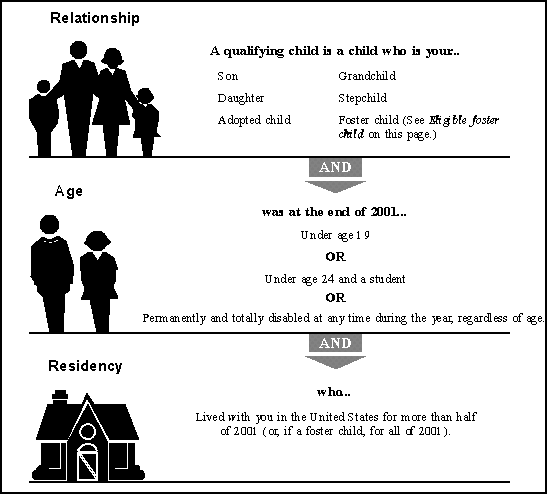
The three tests are illustrated in Figure 2 on page 12. The paragraphs that follow contain more information about each test. Relationship TestYour child must be either your son, daughter, adopted child, grandchild, stepchild, or eligible foster child. The following definitions clarify the relationship test. Adopted child. Your adopted child includes a child placed with you for adoption by an authorized placement agency, even if the adoption is not final. An authorized placement agency includes any person authorized by state law to place children for legal adoption. Grandchild. For the EIC, this means any descendant of your son, daughter, or adopted child. For example, a grandchild includes your great-grandchild, great-great-grandchild, etc. Child not a dependent. Your child does not have to be your dependent to be a qualifying child, unless he or she is married. Married child. If your child was married at the end of the year, he or she does not meet the relationship test unless either of these two situations applies to you:
Figure 2. Tests for Qualifying Child Conditions for Qualifying Child Eligible foster child. For the EIC, a person is your eligible foster child if all the following are true.
Example. Eligible foster child You and your sister live together. You are 30. Your sister is 15. When your parents died 2 years ago, you took over the care of your sister, but you did not adopt her. She is considered your eligible foster child because she lived with you all year and because you cared for her as you would your own child. Age TestYour child must be:
Example. Your son turned 19 on December 10. Unless he was disabled or a full-time student, he is not a qualifying child because, at the end of the year, he was not under age 19. Full-time student. A full-time student is a student who is enrolled for the number of hours or courses the school considers to be full-time attendance. Student defined. To qualify as a student, your child must be, during some part of each of any 5 calendar months during the calendar year:
The 5 calendar months need not be consecutive. School defined. A school can be an elementary school, junior or senior high school, college, university, or technical, trade, or mechanical school. However, on-the-job training courses, correspondence schools, and night schools do not count as schools for the EIC. (But see Night school, later.) Vocational high school students. Students who work in co-op jobs in private industry as a part of a school's regular course of classroom and practical training are considered full-time students. Night school. Your child is not a full-time student if he or she attends school only at night. However, full-time attendance at a school may include some attendance at night as part of a full-time course of study. Permanently and totally disabled. Your child is permanently and totally disabled if both of the following apply.
Residency TestYour child must have lived with you in the United States for more than half of 2001 (all of 2001 if an eligible foster child). The following definitions clarify the residency test. Home. Your home can be any location where you regularly live within one of the 50 states or the District of Columbia. Homeless shelter. You do not need a traditional home. For example, if your child lived with you for more than half the year in one or more homeless shelters, your child meets the residency test. Military personnel stationed outside the United States. U.S. military personnel stationed outside the United States on extended active duty are considered to live in the United States during that duty period for purposes of the EIC. Extended active duty. Extended active duty means you are called or ordered to duty for an indefinite period or for a period of more than 90 days. Once you begin serving your extended active duty, you are still considered to have been on extended active duty even if you do not serve more than 90 days. Birth or death of child. A child who was born or died in 2001 is treated as meeting the residency test if your home was the child's home the entire time he or she was alive in 2001. Temporary absences. Count time that you or your child is away from home on a temporary absence due to a special circumstance as time lived at home. Examples of a special circumstance include:
Kidnapped child. A kidnapped child is treated as living with you for more than half of the year if the child lived with you for more than half the part of the year before the date of the kidnapping. The child must be presumed by law enforcement authorities to have been kidnapped by someone who is not a member of your family or the child's family. This treatment applies for all years that the child remains kidnapped. However, the last year this treatment can apply is the earlier of:
If your qualifying child has been kidnapped and meets these requirements, enter "KC," instead of a number, on line 6 of Schedule EIC.
Social security number. Your qualifying child must have a valid social security number (SSN), unless the child was born and died in 2001. You cannot claim the EIC on the basis of a qualifying child if:
If you have two qualifying children and only one has a valid SSN, you can claim the EIC only on the basis of that child. For more information about SSNs, see Rule 1. |