When Do Fishermen Pay Estimated Tax and File Tax Returns?
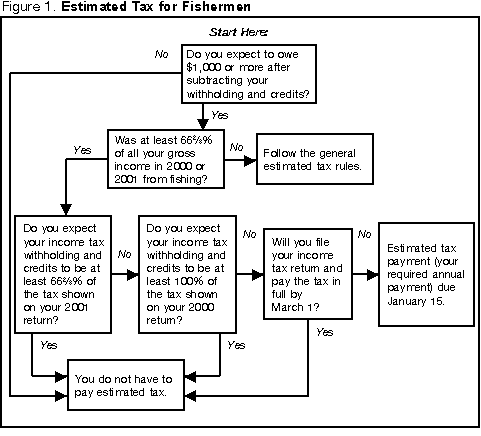
When you must pay estimated tax and file your tax return depends on what percentage of your gross income comes from fishing. Gross income is discussed later. General Rule For Making Estimated Tax PaymentsYou must make estimated tax payments for 2001 if you expect to owe at least $1,000 in tax, after subtracting your withholding and credits, and you expect your withholding and credits to be less than the smaller of the following.
If you receive at least two-thirds of your total gross income from fishing in the current or prior year, special estimated tax and return due dates apply to you. See the discussion under Due Dates for Qualified Fishermen, later. What Is Gross Income?Gross income is all income you receive in the form of money, goods, property, and services that is not exempt from tax. Gross income is not the same as total income shown on line 22 of Form 1040. On a joint return, you must add your spouse's gross income to your gross income. To decide whether two-thirds of your gross income was from fishing, use as your gross income the total amount of the following income (not loss) items from your tax return.
Percentage From FishingFigure your gross income from all sources. Then figure your gross income from fishing. Divide your fishing gross income by your total gross income to determine the percentage from fishing. Example 1. James Smith had the following gross income and fishing income in 2001.
Schedule D showed gain from the sale of a rental house carried over from Form 4797 ($5,000) in addition to a loss from the sale of corporate stock ($2,000). However, that loss is not netted against the gain to figure Mr. Smith's total gross income or his gross fishing income. His gross fishing income is 60% of his total gross income ($75,000 ÷ $125,000 = .60). Therefore, based on his 2001 income, he does not qualify to use the special estimated tax payment and return due dates for 2001, discussed next. However, he would qualify if at least two-thirds of his 2000 gross income was from fishing. Example 2. Assume the same facts as in Example 1 except that Mr. Smith received only $21,500, instead of $41,500, rental income. This made his total gross income $105,000. He qualifies to use the special estimated tax payment and return due dates discussed next, since 71.4% (at least two-thirds) of his gross income is from fishing ($75,000 ÷ $105,000 = .714). Due Dates for Qualified FishermenIf at least two-thirds of your gross income for 2000 or 2001 was from fishing, you are a qualified fisherman and can choose either of the following options for your 2001 tax.
Required annual payment. If at least two-thirds of your gross income for 2000 or 2001 was from fishing, only one estimated tax payment is due. The required annual payment is the smaller of the following amounts.
Fiscal year fishermen. If you qualify to use these special rules but your tax year does not start on January 1, you can file your return and pay the tax by the first day of the 3rd month after the close of your tax year. Or you can make your required annual payment within 15 days after the end of your tax year. Then file your return and pay any balance due by the 15th day of the 4th month after the end of your tax year. Due Dates for Nonqualified FishermenIf less than two-thirds of your gross income for 2000 and 2001 was from fishing, you cannot use the special estimated tax payment procedures described previously for your 2001 tax year. Instead, you should have made quarterly estimated tax payments on April 16, June 15, and September 17, 2001, and on January 15, 2002. You must file your return by April 15, 2002. If less than two-thirds of your gross income for 2001 and 2002 is from fishing, you cannot use these special estimated tax payment and return due dates for your 2002 tax year. You generally must make quarterly estimated tax payments on April 15, June 17, and September 16, 2002, and on January 15, 2003. You must file your return by April 15, 2003. For more information on estimated taxes, see Publication 505. Estimated Tax Penalty for 2001If you did not pay all your required estimated tax for 2001, use Form 2210-F, Underpayment of Estimated Tax by Farmers and Fishermen, to determine if you owe a penalty. If you owe a penalty but do not file Form 2210-F with your return and pay the penalty, you will get a notice from the IRS. You should pay the penalty as instructed by the notice.
Other Filing Information for 2001
Payment date on holiday or weekend. If the last day for filing your return or making a payment falls on a Saturday, Sunday, or legal holiday, your return or payment will be on time if it is filed or made on the next business day. The actual filing and payment due dates provided in this publication generally reflect this adjustment for Saturdays, Sundays, and legal holidays. Extension of time to file Form 1040. If you choose not to file your 2001 return by March 1, 2002, the due date for your return will be April 15, 2002. However, you generally can get an automatic 4-month extension of time to file your return. Your Form 1040 would then be due by August 15, 2002. You can get this extension by filing Form 4868, Application for Automatic Extension of Time To File U.S. Individual Income Tax Return, by April 15, 2002. You can also get an extension by using IRS e-file. Form 4868 does not extend the time for paying taxes. For more information, see the instructions for Form 4868.
|
 2002 tax. If at least two-thirds of your gross income
for 2001 or 2002 is from fishing, you can choose either of the
following options for 2002.
2002 tax. If at least two-thirds of your gross income
for 2001 or 2002 is from fishing, you can choose either of the
following options for 2002.
 Do not ignore a penalty notice, even if you think it is in
error.
You may get a penalty notice even
though you filed your return on time, attached Form 2210-F, and
met the gross income from fishing test. If you receive a penalty
notice for underpaying estimated tax that you think is in error, write
to the address on the notice and explain why you think the notice is
in error. Include a computation, similar to the one in Example 1
(under Percentage From Fishing, earlier), showing that you
met the gross income from fishing test.
Do not ignore a penalty notice, even if you think it is in
error.
You may get a penalty notice even
though you filed your return on time, attached Form 2210-F, and
met the gross income from fishing test. If you receive a penalty
notice for underpaying estimated tax that you think is in error, write
to the address on the notice and explain why you think the notice is
in error. Include a computation, similar to the one in Example 1
(under Percentage From Fishing, earlier), showing that you
met the gross income from fishing test.