Includible Compensation for Your Most Recent Year of ServiceFor 2002, you will need to figure your includible compensation for your most recent year of service for purposes of figuring your limit on annual additions as discussed in Chapter 9. After you have figured your years of service, the next step in figuring your MEA is determining your includible compensation for your most recent year of service. When figuring includible compensation for your most recent year of service, do not mix compensation or service of one employer with compensation or service of another employer. Most Recent Year of ServiceYour most recent year of service is your last full year of service, ending on the last day of your tax year that you worked for the employer that maintains a 403(b) account on your behalf. To figure your most recent year of service, you will need to understand the rules discussed under Years of Service, earlier. When determining your includible compensation, for purposes of figuring your MEA, keep in mind that your most recent year of service may not be the same as your employer's most recent annual work period. This can happen if your tax year is not the same as your employer's annual work period. Tax year different from employer's annual work period. If your tax year is not the same as your employer's annual work period, your most recent year of service is made up of parts of at least two of your employer's annual work periods. Example. A professor who reports her income on a calendar-year basis is employed on a full-time basis by a university that operates on an academic year (October through May). For purposes of figuring her MEA for 2001, the professor's most recent year of service consists of her service performed during January through May of 2001 and her service performed during October through December of 2001. Figuring Your Most Recent Year of Service
After identifying a full year of service, begin counting the service you have provided for your employer starting with the service provided in the current year. To help you count your years of service, follow the rules discussed under Figuring Your Years of Service, earlier. Part-time or employed only part of year. If you are a part-time employee, or a full-time employee who is employed for only part of the year, your most recent year of service consists of your service this year and your service for as many previous years as is necessary to total one full year of service. You add up your most recent periods of service to determine your most recent year of service. First, take into account your service during the year for which you are figuring the MEA (the limit on annual additions for 2002). Then add your service during your next preceding tax year, and years before that, until your total service equals one year of service. Example. You were employed on a full-time basis during the months July through December 1999 (1/2 year of service), July through December 2000 (1/2 year of service), and October through December 2001 (1/4 year of service). Your most recent year of service for purposes of computing your MEA for 2001 is the total of your service during 2001 (1/4 year of service), your service during 2000 (1/2 year of service), and your service during the months October through December 1999 (1/4 year of service). Not yet employed for one year. If, at the close of the year, you have not yet worked for your employer for one year (including time you worked for the same employer in earlier years), use the period of time you have worked for the employer as your most recent year of service. Includible CompensationAfter identifying your most recent year of service, the next step is to identify the includible compensation associated with that full year of service. Includible compensation is not the same as income included on your tax return. Compensation is a combination of income and benefits received in exchange for services provided to your employer. Generally, includible compensation is the amount of income and benefits:
Includible compensation does include the following amounts.
Includible compensation does not include the following items.
Note. If you are a church employee or a foreign missionary, figure includible compensation for 2001 using the method explained in chapter 7. For information on figuring includible compensation for 2002 see chapter 9. Cost of Incidental Life InsuranceIncludible compensation does not include the cost of incidental life insurance. Note. If all of your 403(b) accounts invest only in mutual funds, then you have no incidental life insurance. If you have an annuity contract, a portion of the cost of that contract may be for incidental life insurance. If so, the cost of the insurance is taxable to you in the year contributed and is considered part of your basis when distributed. Your employer will include the cost of your insurance as taxable wages in box 1 of Form W-2. Not all annuity contracts include life insurance. Contact your plan administrator to determine if your account includes incidental life insurance. If it does, you will need to figure the cost of life insurance each year the policy is in effect.
To determine the amount of the life insurance premiums you will need to know the following information.
Example. Your new contract provides that your beneficiary will receive $10,000 if you should die anytime before retirement. Your cash value in the contract at the end of the first year is zero. Your current life insurance protection for the first year is $10,000 ($10,000 minus 0). The cash value in the contract at the end of year two is $1,000, and the current life insurance protection for the second year is $9,000 ($10,000 - $1,000). You can use Worksheet B in chapter 13 to determine the cost of your life insurance. The one-year cost of the protection can be calculated by using Figure 3-1, Uniform One-Year Term Premiums for $1,000 Life Insurance Protection. The premium rate is determined according to your age on your birthday nearest the beginning of the policy year.
Note. If the current published premium rates per $1,000 of insurance protection charged by an insurer for individual one-year term
life insurance premiums available to all standard risks are lower than those in the preceding table, you can use the lower rates for figuring the cost
of insurance in connection with individual policies issued by the same insurer.
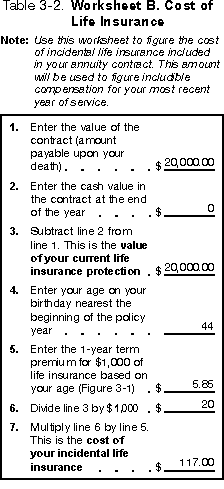
Example. Lynne Green and her employer enter into a 403(b) plan that will provide her with a $500 a month annuity upon retirement at age 65. The agreement also provides that if she should die before retirement, her beneficiary will receive the greater of $20,000 or the cash surrender value in the life insurance contract. Using the facts presented we can determine the cost of Lynne's life insurance protection as shown in Table 3-2.
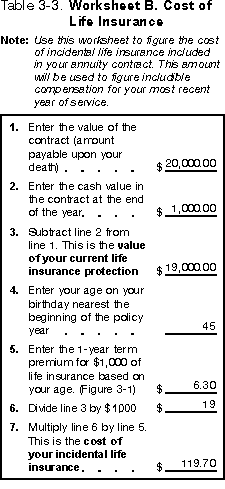
Lynne's employer has included $117 for the cost of the life insurance protection in her current year's income. When figuring her includible compensation for this year, Lynne will subtract $117. Example. Lynne's cash value in the contract at the end of the second year is $1,000. In year two, the cost of Lynne's life insurance is calculated as shown in Table 3-3.
In year two, Lynne's employer will include $119.70 in her current year's income. Lynne will subtract this amount when figuring her includible compensation. Figuring Includible Compensation for Your Most Recent Year of Service
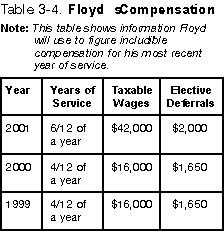
Example. Floyd has been periodically working full time for a local hospital since September 1998. He needs to figure his MEA for 2001. The hospital's normal annual work period for employees in Floyd's general type of work runs from January to December. During the periods that Floyd was employed with the hospital, the hospital has always been eligible to provide a 403(b) plan to employees. Additionally, the hospital has never provided the employees with a 457 deferred compensation plan, transportation benefits, or a cafeteria plan. Floyd has never worked abroad. There is no life insurance provided under the plan and contributions to Floyd's account have never been more than his MEA. Table 3-4 shows the service Floyd provided to his employer, his compensation for the periods worked and his elective deferrals. The increase between 2000 and 2001 is due to new skills.
Before Floyd can figure his MEA, he must figure includible compensation for his most recent year of service. Because Floyd did not work for the entire year in 2001, his most recent year of service will include the time he worked in 2001 plus time he worked in earlier years until the time he worked for the hospital totals one year. If the total is less than one year, Floyd will treat it as if it were one year. He figures his most recent year of service shown in the following list.
Using the information provided in Table 3-4, wages for Floyd's most recent year of service are $66,000 ($42,000 + $16,000 + $8,000) and his includible compensation for his most recent year of service is figured as shown in Table 3-5. | ||||||||||||||||||||||||||||||||||||||||||||||||||||||||||||||||||||||||||||||||||||||||||||||||||||||||||||||||||||||||||||||||||||||||||||||||||||||||||||||||||||||||||||||||||||||
 To figure your most recent year of service, begin by determining what constitutes a full year of service for your position. A full year of service
is equal to full-time employment for your employer's annual work period.
To figure your most recent year of service, begin by determining what constitutes a full year of service for your position. A full year of service
is equal to full-time employment for your employer's annual work period.