Credit for the Elderly or the DisabledThis section explains who qualifies for the credit for the elderly or the disabled and how to figure this credit. The maximum credit available is $1,125. You may be able to take this credit if you are age 65 or older, or if you are retired on permanent and total disability.
Credit figured for you. If you choose to have the IRS figure the credit for you, see Publication 524, Credit for the Elderly or the Disabled. If you want the IRS to figure your tax, see Publication 967, The IRS Will Figure Your Tax. Can You Take the Credit?You can take the credit for the elderly or the disabled if:
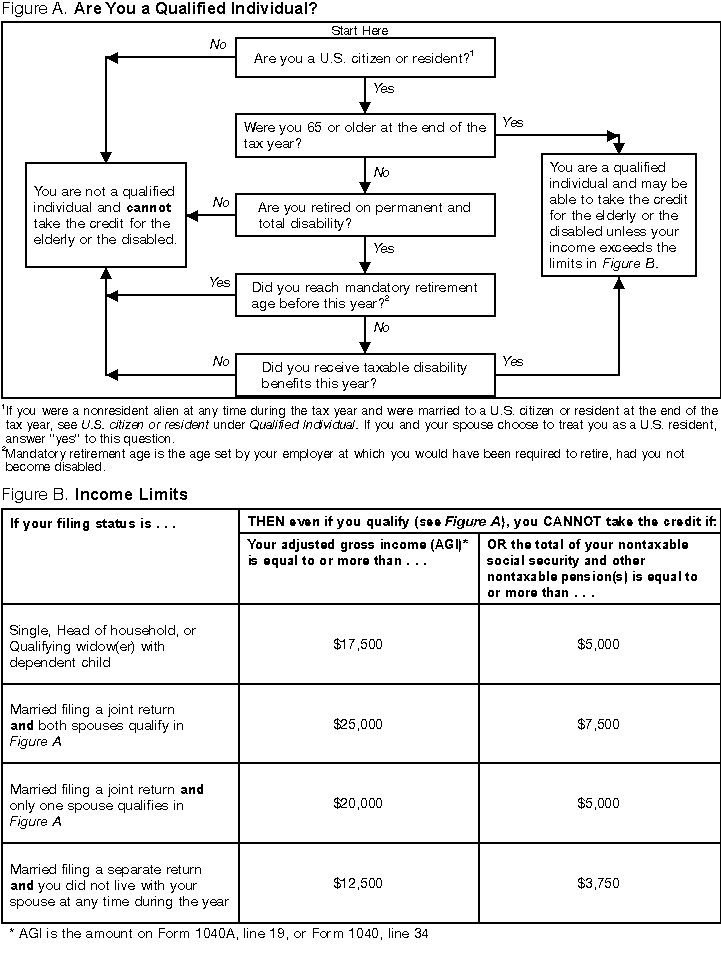
Figures A and A. Are you a qualified individual? Qualified IndividualYou are a qualified individual for this credit if you are a U.S. citizen or resident, and either of the following applies.
U.S. citizen or resident. You must be a U.S. citizen or resident (or be treated as a resident) to take the credit. Generally, you cannot take the credit if you were a nonresident alien at any time during the tax year. Exceptions. You may be able to take the credit if you are a nonresident alien who is married to a U.S. citizen or resident at the end of the tax year and you and your spouse choose to treat you as a U.S. resident. If you make that choice, both you and your spouse are taxed on your worldwide income. If you were a nonresident alien at the beginning of the year and a resident at the end of the year, and you were married to a U.S. citizen or resident at the end of the year, you may be able to choose to be treated as a U.S. resident for the entire year. In that case, you may be allowed to take the credit. For information on these choices, see chapter 1 of Publication 519, U.S. Tax Guide for Aliens. Married persons. Generally, if you are married at the end of the tax year, you and your spouse must file a joint return to take the credit. However, if you and your spouse did not live in the same household at any time during the tax year, you can file either a joint return or separate returns and still take the credit. Head of household. You can file as head of household and qualify to take the credit even if your spouse lived with you during the first 6 months of the year if you meet all of the tests. See Publication 524 and Publication 501. Under age 65. If you are under age 65, you can qualify for the credit only if you are retired on permanent and total disability. You are retired on permanent and total disability if:
Even if you do not retire formally, you are considered retired on disability when you have stopped working because of your disability. If you retired on disability before 1977, see Publication 524. Permanent and total disability. You are permanently and totally disabled if you cannot engage in any substantial gainful activity because of your physical or mental condition. A physician must certify that the condition has lasted or can be expected to last continuously for 12 months or more, or that the condition can be expected to result in death. See Physician's statement, later. Substantial gainful activity. Substantial gainful activity is the performance of significant duties over a reasonable period of time while working for pay or profit, or in work generally done for pay or profit. Full-time work (or part-time work done at the employer's convenience) in a competitive work situation for at least the minimum wage conclusively shows that you are able to engage in substantial gainful activity. Substantial gainful activity is not work you do to take care of yourself or your home. It is not unpaid work on hobbies, institutional therapy or training, school attendance, clubs, social programs, and similar activities. However, doing this kind of work may show that you are able to engage in substantial gainful activity. The fact that you have not worked for some time is not, of itself, conclusive evidence that you cannot engage in substantial gainful activity. The following examples illustrate the tests of substantial gainful activity. Example 1. Trisha, a sales clerk, retired on disability. She is 53 years old and now works as a full-time babysitter for minimum wage. Even though Trisha is doing different work, she is able to perform the duties of her new job in a full-time competitive work situation for the minimum wage. She cannot take the credit because she is able to engage in substantial gainful activity. Example 2. Tom, a bookkeeper, retired on disability. He is 59 years old and now drives a truck for a charitable organization. He sets his own hours and is not paid. Duties of this nature generally are performed for pay or profit. Some weeks he works 10 hours and some weeks he works 40 hours. Over the year he averages 20 hours a week. The kind of work and his average hours a week conclusively show that Tom is able to engage in substantial gainful activity. This is true even though Tom is not paid and he sets his own hours. He cannot take the credit. Example 3. John, who retired on disability, took a job with a former employer on a trial basis. The purpose of the job was to see if John could do the work. The trial period lasted for 6 months during which John was paid the minimum wage. Because of John's disability, he was assigned only light duties of a nonproductive make-work nature. The activity was gainful because John was paid at least the minimum wage. But the activity was not substantial because his duties were nonproductive. These facts do not, by themselves, show that John is able to engage in substantial gainful activity. Example 4. Joan, who retired on disability from employment as a bookkeeper, lives with her sister who manages several motel units. Joan assists her sister for 1 or 2 hours a day by performing duties such as washing dishes, answering phones, registering guests, and bookkeeping. Joan can select the time during the day when she feels most fit to perform the tasks undertaken. Work of this nature, performed off and on during the day at Joan's convenience, is not activity of a substantial and gainful nature even if she is paid for the work. The performance of these duties does not, of itself, show that Joan is able to engage in substantial gainful activity. Sheltered employment. Certain work offered at qualified locations to physically or mentally impaired persons is considered sheltered employment. These qualified locations are in sheltered workshops, hospitals and similar institutions, homebound programs, and Department of Veterans Affairs (VA) sponsored homes. Compared to commercial employment, pay is lower for sheltered employment. Therefore, one usually does not look for sheltered employment if he or she can get other employment. The fact that one has accepted sheltered employment is not proof of the person's ability to engage in substantial gainful activity. Physician's statement. If you are under 65, you must have your physician complete a statement certifying that you are permanently and totally disabled on the date you retired. You do not have to file this statement with your Form 1040 or Form 1040A, but you must keep it for your records. The instructions for either Schedule R (Form 1040) or Schedule 3 (Form 1040A) include a statement your physician can complete and that you can keep for your records. If you got a physician's statement in an earlier year and, due to your continued disabled condition, you were unable to engage in any substantial gainful activity during 2001, you may not need to get another physician's statement for 2001. For a detailed explanation of the conditions you must meet, see the instructions for Part II of Schedule R (Form 1040) or of Schedule 3 (Form 1040A). If you meet the required conditions, you must check the box on line 2 of Part II of Schedule R (Form 1040) or of Schedule 3 (Form 1040A). If you checked box 4, 5, or 6 in Part I of either Schedule R or Schedule 3, print in the space above the box on line 2 of Part II, the first name(s) of the spouse(s) for whom the box is checked. Disability income. If you are under age 65, you can qualify for the credit only if you have taxable disability income. Disability income must meet the following two requirements.
Payments that are not disability income. Any payment you receive from a plan that does not provide for disability retirement is not disability income. Any lump-sum payment for accrued annual leave that you receive when you retire on disability is a salary payment and is not disability income. For purposes of the credit for the elderly or the disabled, disability income does not include amounts you receive after you reach mandatory retirement age. Mandatory retirement age is the age set by your employer at which you would have had to retire had you not become disabled. Income LimitsTo determine if you can claim the credit, you must consider two income limits. The first limit is the amount of your adjusted gross income (AGI). The second limit is the amount of nontaxable social security or other nontaxable pensions you received. The limits are shown in Figure B. If the amount of your AGI and nontaxable pensions are less than the income limits, you may be able to claim the credit.
Figuring the CreditIf you figure the credit yourself, fill out the front of either Schedule R (if you are filing Form 1040) or Schedule 3 (if you are filing Form 1040A). Next, fill out Part III of either Schedule R or Schedule 3. There are four steps in Part III to determine the amount of your credit.
Limit on CreditThe amount of credit you can claim may be limited. Use one of the worksheets in Publication 524 (or the worksheet in the instructions for Schedule 3, Form 1040A, or Schedule R, Form 1040, whichever applies) to determine the amount of credit you can claim if any of the following apply.
If 1, 2, and 3 above do not apply, you do not need to use a worksheet to figure a limit on your credit. Claim the full amount of the credit you figured on Schedule 3 (Form 1040A) or Schedule R (Form 1040). |
 You can take the credit only if you file Form 1040 or Form 1040A. You cannot take the credit if you file Form 1040EZ.
 Age 65. You are considered to be age 65 on the day before your 65th birthday. Therefore, you are age 65 at the end of the year if your
65th birthday is on or before January 1 of the following year.
Age 65. You are considered to be age 65 on the day before your 65th birthday. Therefore, you are age 65 at the end of the year if your
65th birthday is on or before January 1 of the following year.