Limits on DeductionsIf your total contributions for the year are 20% or less of your adjusted gross income, you do not need to read this section. The limits discussed here do not apply to you. The amount of your deduction may be limited to either 20%, 30%, or 50% of your adjusted gross income, depending on the type of property you give and the type of organization you give it to. These limits are described below. If your contributions are more than any of the limits that apply, see Carryovers under How To Figure Your Deduction When Limits Apply, later. Out-of-pocket expenses. Amounts you spend performing services for a charitable organization, which qualify as charitable contributions, are subject to the limit of the organization. For example, the 50% limit applies to amounts you spend on behalf of a church, a 50% limit organization. These amounts are considered a contribution to a qualified organization. 50% LimitThe 50% limit applies to the total of all charitable contributions you make during the year. This means that your deduction for charitable contributions cannot be more than 50% of your adjusted gross income for the year. Only limit for 50% organizations. The 50% limit is the only limit that applies to gifts to organizations listed below under 50% Limit Organizations. But there is one exception. Exception. The 30% limit also applies to these gifts if they are gifts of capital gain property for which you figure your deduction using fair market value without reduction for appreciation. (See 30% Limit later.) 50% Limit OrganizationsYou can ask any organization whether it is a 50% limit organization, and most will be able to tell you. Or you may check IRS Publication 78 (described earlier). Only the following types of organizations are 50% limit organizations.
30% LimitThe 30% limit applies to the following gifts.
Student living with you. Amounts you spend on behalf of a student living with you are subject to the 30% limit. These amounts are considered a contribution for the use of a qualified organization. 20% LimitThe 20% limit applies to all gifts of capital gain property to or for the use of qualified organizations (other than gifts of capital gain property to 50% limit organizations).
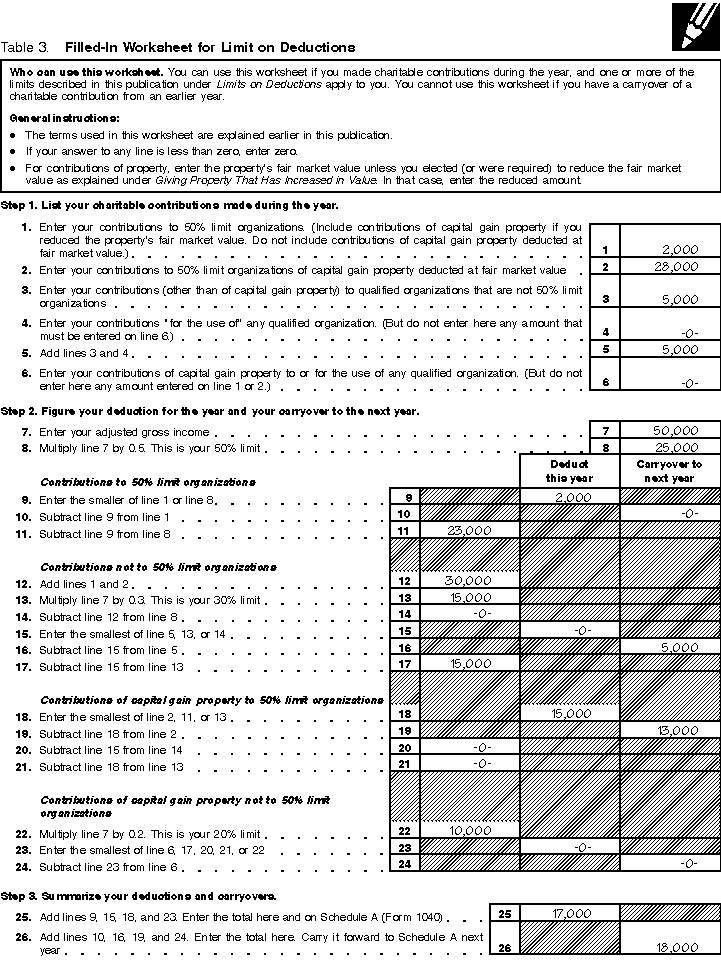
Table 3 - Filled in worksheet for deduction computation How To Figure Your Deduction When Limits ApplyIf your contributions are subject to more than one of the limits just discussed, you can deduct them as follows.
If more than one of the limits described above limit your deduction for charitable contributions, you may want to use the worksheet in Table 4 on page 16 to figure your deduction and your carryover.
Example. Your adjusted gross income is $50,000. During the year, you gave your church $2,000 cash and land with a fair market value of $28,000 and a basis of $22,000. You held the land for investment purposes. You do not choose to reduce the fair market value of the land by the appreciation in value. You also gave $5,000 cash to a private foundation to which the 30% limit applies. The $2,000 cash donated to the church is considered first and is fully deductible. Your contribution to the private foundation is considered next. Because your contributions to 50% limit organizations ($2,000 + $28,000) are more than $25,000 (50% of $50,000), your contribution to the private foundation is not deductible for the year. It can be carried over to later years. See Carryovers, later. The gift of land is considered next. Your deduction for the land is limited to $15,000 (30% × $50,000). The unused part of the gift of land ($13,000) can be carried over. For this year, your deduction is limited to $17,000 ($2,000 + $15,000). A Filled-In Worksheet for Limit on Deductions in Table 3 on page 11 shows this computation in detail. Capital gain property election. You may choose the 50% limit for gifts of capital gain property to 50% limit organizations instead of the 30% limit that would otherwise apply. If you make this choice, you must reduce the fair market value of the property contributed by the appreciation in value that would have been long-term capital gain if the property had been sold. This choice applies to all capital gain property contributed to 50% limit organizations during a tax year. It also applies to carryovers of this kind of contribution from an earlier tax year. For details, see Carryover of capital gain property, later. You must make the choice on your original return or on an amended return filed by the due date for filing the original return. Example. In the previous example, if you choose to have the 50% limit apply to the land (the 30% capital gain property) given to your church, you must reduce the fair market value of the property by the appreciation in value. Therefore, the amount of your charitable contribution for the land would be its basis to you of $22,000. You add this amount to the $2,000 cash contributed to the church. You can now deduct $1,000 of the amount donated to the private foundation because your contributions to 50% limit organizations ($2,000 + $22,000) are $1,000 less than the 50%-of-adjusted-gross-income limit. Your total deduction for the year is $25,000 ($2,000 cash to your church, $22,000 for property donated to your church, and $1,000 cash to the private foundation). You can carry over to later years the part of your contribution to the private foundation that you could not deduct ($4,000). CarryoversYou can carry over your contributions that you are not able to deduct in the current year because they exceed your adjusted-gross-income limits. You can deduct the excess in each of the next 5 years until it is used up, but not beyond that time. Your total contributions deduction for the year to which you carry your contributions cannot exceed 50% of your adjusted gross income for that year. Contributions you carry over are subject to the same percentage limits in the year to which they are carried. For example, contributions subject to the 20% limit in the year in which they are made are 20% limit contributions in the year to which they are carried. For each category of contributions, you deduct carryover contributions only after deducting all allowable contributions in that category for the current year. If you have carryovers from 2 or more prior years, use the carryover from the earlier year first. Example 1. Last year, you contributed $11,000 to a 50% limit organization, but because of the limit you deducted only $10,000 and carried over $1,000 to this year. This year your adjusted gross income is $20,000 and you contribute $9,500 to a 50% limit organization. You can deduct $10,000 (50% of $20,000) this year. Consequently, in addition to your contribution of $9,500 for this year, you can deduct $500 of your carryover contribution from last year. You can carry over the $500 balance of your carryover from last year to next year. Example 2. This year your adjusted gross income is $24,000. You make cash contributions of $6,000 to which the 50% limit applies and $3,000 to which the 30% limit applies. You have a contribution carryover from last year of $5,000 for capital gain property contributed to a 50% limit organization and subject to the 30% limit for contributions of capital gain property. Your contribution deduction for this year is limited to $12,000 (50% of $24,000). Your 50% limit contributions of $6,000 are fully deductible. The deduction for your 30% limit contributions of $3,000 is limited to $1,000. This is the lesser of:
The deduction for your $5,000 carryover is subject to the 30% limit for contributions of capital gain property. This means it is limited to the smaller of:
Your deduction is $12,000 ($6,000 + $1,000 + $5,000). You carry over the $2,000 balance of your 30% limit contributions for this year to next year. Carryover of capital gain property. If you carry over contributions of capital gain property subject to the 30% limit and you choose in the next year to use the 50% limit and take appreciation into account, you must refigure the carryover. You reduce the fair market value of the property by the appreciation and reduce that result by the amount actually deducted in the previous year. Example. Last year your adjusted gross income was $50,000 and you contributed capital gain property valued at $27,000 to a 50% limit organization and did not choose to use the 50% limit. Your basis in the property was $20,000. Your deduction was limited to $15,000 (30% of $50,000), and you carried over $12,000. This year your adjusted gross income is $60,000 and you contribute capital gain property valued at $25,000 to a 50% limit organization. Your basis in the property is $24,000 and you choose to use the 50% limit. You must refigure your carryover as if you had taken appreciation into account last year as well as this year. Because the amount of your contribution last year would have been $20,000 (the property's basis) instead of the $15,000 you actually deducted, your refigured carryover is $5,000 ($20,000 - $15,000). Your total deduction this year is $29,000 (your $24,000 current contribution plus your $5,000 carryover). Additional rules for carryovers. Special rules exist for computing carryovers if you:
|