Filing StatusYour filing status is used in determining whether you must file a return, your standard deduction, and the correct tax. It may also be used in determining whether you can claim certain deductions and credits. The filing status you can choose depends partly on your marital status on the last day of your tax year. Marital status. If you are considered unmarried, your filing status is single or, if you meet certain requirements, head of household or qualifying widow(er). If you are considered married, your filing status is either married filing a joint return or married filing a separate return. For information about the single and qualifying widow(er) filing statuses, see Publication 501. Considered unmarried. You are considered unmarried for the whole year if either of the following applies.
Considered married. You are considered married for the whole year if you are separated but you have not obtained a final decree of divorce or separate maintenance by the last day of your tax year. An interlocutory decree is not a final decree. Exception. If you live apart from your spouse, under certain circumstances you may be considered unmarried and can file as head of household. See Head of Household, later. Joint ReturnIf you are married, you and your spouse can choose to file a joint return. If you file jointly, you both must include all your income, exemptions, deductions, and credits on that return. You can file a joint return even if one of you had no income or deductions.
To file a joint return, at least one of you must be a U.S. citizen or resident at the end of the tax year. If either of you was a nonresident alien at any time during the tax year, you can file a joint return only if you agree to treat the nonresident spouse as a resident of the United States. This means that your combined worldwide incomes are subject to U.S. income tax. These rules are explained in Publication 519, U.S. Tax Guide for Aliens. Signing a joint return. Both you and your spouse must sign the return, or it will not be considered a joint return. Joint and individual liability. Both you and your spouse are responsible, jointly and individually, for the tax and any interest or penalty due on your joint return. This means that one spouse may be held liable for all the tax due even if all the income was earned by the other spouse. Divorced taxpayers. If you are divorced, you are still jointly and individually responsible for any tax, interest, and penalties due on a joint return for a tax year ending before your divorce. This responsibility applies even if your divorce decree states that your former spouse will be responsible for any amounts due on previously filed joint returns. Relief from joint liability. In some cases, a spouse will be relieved of the tax, interest, and penalties on a joint return. You can ask for relief no matter how small the liability. There are three types of relief available.
Innocent spouse relief and separation of liability apply only to items incorrectly reported on the return. If a spouse does not qualify for innocent spouse relief or separation of liability, the IRS may grant equitable relief. Each of these kinds of relief is different, and they each have different requirements. You must file Form 8857 to request any of these kinds of relief. Publication 971 explains these kinds of relief and who may qualify for them. Tax refund applied to spouse's debts. The overpayment shown on your joint return may be used to pay the past-due amount of your spouse's debts. You can get your share of the refund if you qualify as an injured spouse. Injured spouse. You are an injured spouse if you file a joint return and all or part of your share of the overpayment was, or is expected to be, applied against your spouse's past-due federal tax, state income tax, child or spousal support, or federal nontax debt, such as a student loan. You should file Form 8379, if you meet all three of the following conditions.
If all three of the above apply and you want your share of the overpayment shown on the joint return refunded to you, complete Form 8379. If your main home was in a community property state (see Community Property, later), you can file Form 8379 if only item 1 applies. Follow the instructions on the form.
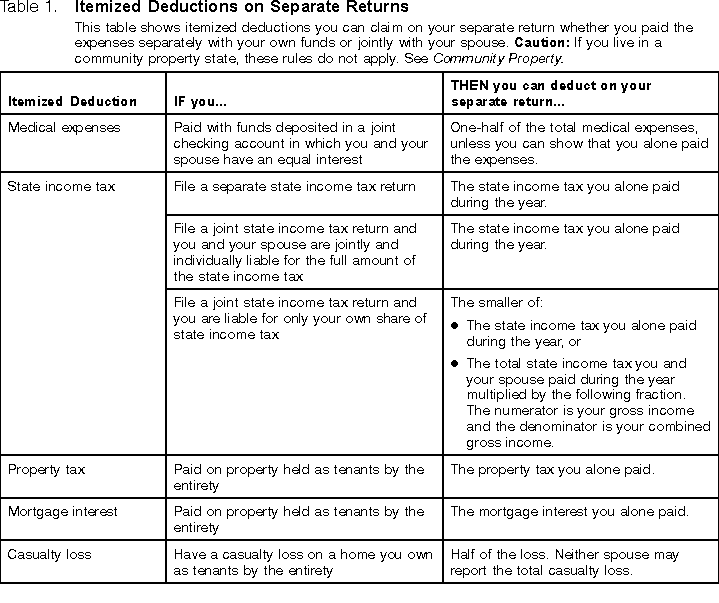
Separate ReturnsIf you and your spouse file separate returns, you should each report only your own income, exemptions, deductions, and credits on your individual return. You can file a separate return even if only one of you had income. For information on exemptions you can claim on your separate return, see Exemptions, later. Community or separate income. If you live in a community property state and file a separate return, your income may be separate income or community income for income tax purposes. For more information, see Community Income under Community Property, later. Separate liability. If you and your spouse file separately, you each are responsible only for the tax due on your own return. Itemized deductions. If you and your spouse file separate returns and one of you itemizes deductions, the other spouse will not qualify for the standard deduction and should also itemize deductions. Dividing itemized deductions. You may be able to claim itemized deductions on a separate return for certain expenses that you paid separately or jointly with your spouse. See Table 1. Table 1. Itemized Deductions on Separate ReturnsDeductions Separate returns may give you a higher tax. Some married couples file separate returns because each wants to be responsible only for his or her own tax. But in almost all instances, if you file separate returns, you will pay more combined federal tax than you would with a joint return. This is because the tax rate is higher for married persons filing separately. The following rules also apply if you file a separate return.
Joint return after separate returns. If either you or your spouse files a separate return, you can change to a joint return any time within 3 years from the due date (not including extensions) of the separate returns. This applies even if either of you filed as head of household. Use Form 1040X. Separate returns after joint return. After the due date of your return, you and your spouse cannot file separate returns if you previously filed a joint return. Exception. A personal representative for a decedent can change from a joint return elected by the surviving spouse to a separate return for the decedent. The personal representative has one year from the due date of the joint return to make the change. Head of HouseholdYou may be eligible to file as head of household if you meet the requirements discussed later. Filing as head of household has the following advantages.
Requirements. You can file as head of household only if you were unmarried or considered unmarried on the last day of the year. You also must have paid more than half the cost of keeping up a home that was the main home for more than half the year (except for temporary absences, such as for school) for you and any of the following qualifying persons.
Father or mother. If your parent for whom you can claim an exemption does not live with you, you can file as head of household if you paid more than half the cost of keeping up a home that was your parent's main home for the entire year. This includes paying more than half the cost of keeping your parent in a rest home or home for the elderly. Considered unmarried. Even if you are married, you will be considered unmarried on the last day of the year if you meet all of the following tests.
Nonresident alien spouse. If your spouse was a nonresident alien at any time during the tax year, and you have not chosen to treat your spouse as a resident alien, you are considered unmarried for head of household purposes. However, your spouse is not a qualifying person for head of household purposes. You must have paid most of the cost of keeping up a home that was the main home for most of the year for you and a qualifying person (other than your spouse) and meet the other requirements to file as head of household. Keeping up a home. You are keeping up a home only if you pay more than half the cost of its upkeep. This includes rent, mortgage interest, taxes, insurance on the home, repairs, utilities, and food eaten in the home. This does not include the cost of clothing, education, medical treatment, or transportation for any member of the household. More information. For more information on filing as head of household, get Publication 501. |
 If both you and your spouse have income, you should usually figure
your tax on both a joint return and separate returns to see which
gives you the lower tax.
If both you and your spouse have income, you should usually figure
your tax on both a joint return and separate returns to see which
gives you the lower tax.
 Refunds that involve community property states must be divided
according to local law. If you live in a community property state in
which all community property is subject to the debts of either spouse,
your entire refund can be used to pay those debts.
Refunds that involve community property states must be divided
according to local law. If you live in a community property state in
which all community property is subject to the debts of either spouse,
your entire refund can be used to pay those debts.